Antes de comprar, mira cómo te quedaría el mes.
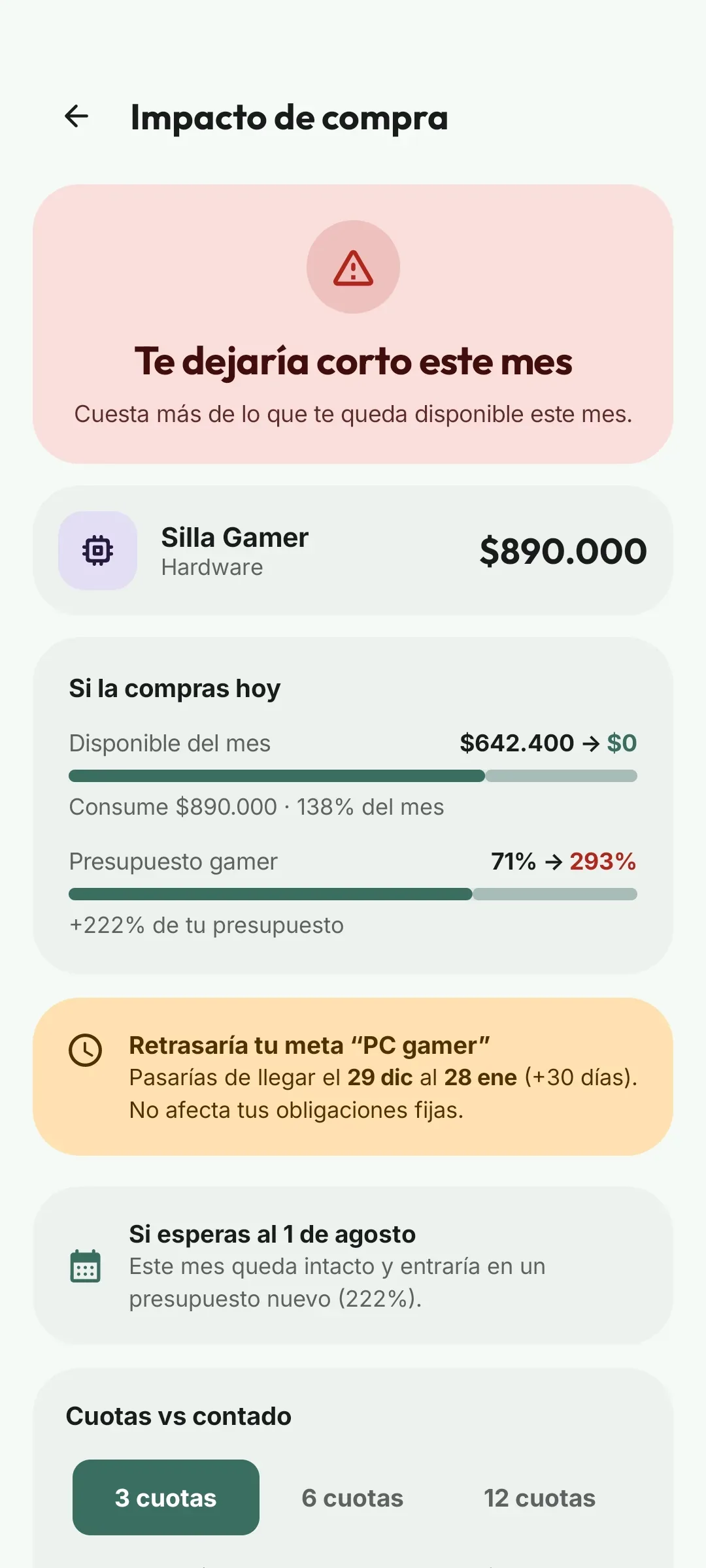
Want that $890,000 chair? Pleloot shows you what would happen if you bought it today.
You’d be left with $0 available this month.
- Available$642,400 → $0
- Gaming budget71 % → 293 %
- “Gaming PC” goal29 Dec → 28 Jan
- Fixed commitmentsUnchanged
Wait until 1 August and you start the month with a fresh budget.
It depends on how you’re left afterwards.
Being able to pay for it isn’t the same as being fine once you have.
- You can afford it
You buy it and you still have room.
Keyboard · $320,000Your goal slips by 11 days. - You can afford it, but only just
You can buy it, but the rest of the month gets tight.
We show you what you’d have left. - It would leave you short
If you buy it today, you’d spend more than you have available.
Gaming chair · $890,000You’d need 138 % of what’s available.
Your balance isn’t the same as what you can use.
Having money in the account doesn’t mean all of it is available. Part of it may be spoken for by your next payments, your goals, or whatever you decided to set aside. Pleloot takes all of that into account and shows you what you have available for the rest of the month.
- In your accounts$5,191,400
- Your cushion− $150,000
Move money between accounts
What people ask about this calculation
Is seeing the impact of a purchase free?
Yes, with no cap. No account, no connection and no Pleloot Pro needed: weighing a purchase before you pay for it is the feature that shows what Pleloot is about, and putting a wall in front of it would turn it into bait. Pro adds the comparison, which puts buying today against waiting until next month, and instalments against paying outright.
Does Pleloot tell me whether to buy it?
No, and that’s deliberate. Pleloot doesn’t give financial orders: it shows you the consequence — what you’d have left, which budget moves, how many days your goal slips — and the decision is yours. An app that tells you “don’t buy it” is guessing what matters in your life.
Where do the numbers come from?
From what you’ve tracked, and only that: your accounts, your transactions, your budgets, your subscriptions and the real pace of your goal contributions. It doesn’t connect to your bank and never asks for its password. If it’s missing something it needs, it says so instead of giving you an invented number.
What is safe capacity?
What you can spend without touching what’s already committed. It’s worked out by taking your balances and subtracting the subscriptions coming up, what you set aside for your goals and the safety margin you chose. That’s why your balance and your capacity almost never match: the bank tells you how much is there, not how much is yours for today.
Does it work for purchases that aren’t gaming?
Yes. The example on this page is a gaming chair because that’s what our community asks about, but the calculation is the same for tuition, a motorbike, a trip or a fridge. Pleloot doesn’t manage your gaming spending: it manages the money of someone who happens to be a gamer.
And if I buy it anyway?
Then you buy it anyway, and Pleloot logs the transaction like any other. That’s the point: it doesn’t exist to make you spend less, it exists so you know what you’re deciding.
Try it on the next one you’re unsure about.
Install it, open it, and it works. Seeing the impact of a purchase is free and needs no account and no connection.
Your money, well played.